Upper-Limb Access and Amputee Rehab Games
Accessible Gaming, Amputee PT, 3D-Printed Prosthetics & Adaptive Controls
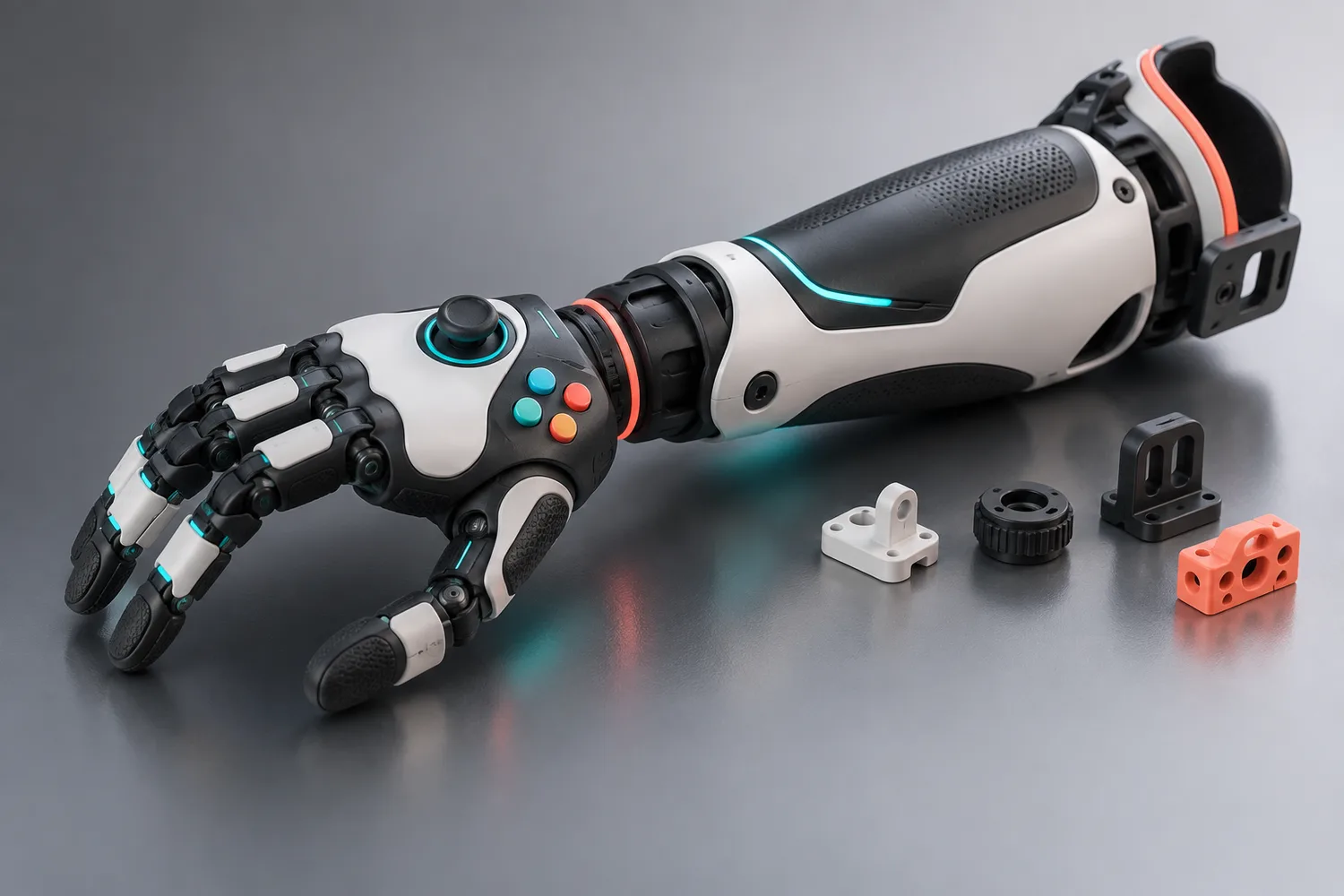
The Challenge
Many games assume the player can hold a controller, reach several buttons quickly, use both hands, or make fine repeated movements for long periods of time.
For players with upper-limb disabilities, including players who use prosthetic hands or custom 3D-printed devices, those assumptions can make otherwise normal games hard or impossible to play. The same camera-tracking and adaptive-control ideas can also support home physical therapy and prosthetic-use training for amputees.
The team behind this challenge is connected to Haifa3D, a nonprofit that creates mostly 3D-printed prosthetics, especially for young people and custom per-person cases. They want to combine game design, open-source 3D printing, and accessibility to help players take part in games they currently cannot play comfortably.
The Big Idea
Can we use game technology to help a person reach a meaningful upper-limb functional goal, while making the practice that leads there more playable, measurable, and worth repeating?
This challenge is not about creating a separate "special needs game." The more interesting goal is to help someone play normal games, or normal-feeling games, with controls and interactions that fit their body, prosthetic, range of motion, and comfort. It can also mean turning prosthetic-use practice or home PT into a repeatable game loop.
Clinician-Recommended Broader Direction
Dr. Aviram Zailer reviewed the concept and thought the narrow goal of only making mainstream games playable may be too shallow. He suggested broadening the challenge to include camera-based physical-therapy practice for amputees, using movement tracking and step-by-step progress monitoring.
One possible setup: the patient practices in front of a mirror while a phone or camera is held or mounted nearby. The game tracks the relevant movement, guides the patient through the next step, and turns repetitive rehabilitation practice into a clearer, more motivating loop.
There is no single generic "arm rehab" routine. The appropriate exercise depends on the diagnosis, stage of recovery, functional goal, age, active movement, pain, fatigue, equipment, supervision, and risk. A prototype should therefore begin with one clearly defined patient profile and a clinician-approved exercise rather than selecting or changing treatment on its own.
For upper-limb recovery, the relevant outcome is functional: what the person can actually do in daily life. Reaching, grasping, releasing, manipulating an object, using both hands, and other component movements are valuable as steps toward that outcome. Game scores, repetition counts, range, and accuracy can help show progress, but they are not the endpoint unless they translate into a meaningful activity.
This connects naturally to the existing accessibility goal. Teams can focus on adaptive controls for play, prosthetic-use practice, home PT for amputees, or a prototype that combines those directions.
Design Questions
- Input: What controls can a player use reliably: one hand, residual limb movement, prosthetic movement, switches, pedals, camera tracking, voice, head movement, or a custom 3D-printed adapter?
- Game selection: Which existing mechanics become accessible with small changes, and which need a different control model?
- Fatigue: How can the game avoid requiring painful, tiring, or unrealistic repeated motions?
- Feedback: How can the player tell that the input was recognized correctly?
- Customization: Can the setup adapt to different prosthetics, different bodies, rehab stages, and player goals?
- Rehab depth: Is the prototype mainly about access to existing games, prosthetic-use training, camera-tracked home PT, or a combination?
- Functional outcome: What meaningful activity is the person trying to regain or access? Can the prototype show how component movements and practice measures lead toward that goal?
- Progress: Can the prototype track successful trials, dropped objects, task time, cue level, range, or accuracy against the person's own baseline without confusing those intermediate measures with functional recovery or pretending to make a clinical judgment?
- Safety: What pain, fatigue, swelling, skin, color, heat, movement-quality, or neurological changes should stop the activity and send the person back to a clinician?
- Camera limits: A consumer camera may count repetitions or estimate a visible movement, but it cannot safely infer strength, sensation, muscle tone, prosthetic fit, or shoulder safety by itself.
What a Jam Prototype Could Be
- A modified version of an existing simple game mechanic with an accessible control scheme.
- A controller-mapping prototype that lets a player use fewer buttons or different movements.
- A low-cost physical adapter or 3D-printed attachment paired with a playable game demo.
- A tutorial game that helps a player practice using a prosthetic or assistive control setup.
- A camera-and-mirror home PT prototype that guides an amputee through step-by-step movement practice and progress tracking.
- A task-practice loop built around reaching, grasping, releasing, object transfer, or another clinician-selected daily activity, with graded assistance and feedback.
- A comparison tool that tests different input methods and shows which one works best for a specific player.
Who Should Join This Challenge
- Game designers who can rethink controls and difficulty around a real player's abilities.
- Developers who can prototype alternate input systems, remapping, camera input, or hardware interfaces.
- Artists and UX designers who can make feedback clear without overloading the player.
- 3D printing / maker participants who can prototype simple physical adapters.
- Clinicians, prosthetics experts, occupational therapists, or people with lived experience who can tell the team what is realistic and useful.
What This Is Not
This is not expected to produce a finished assistive device during the jam.
The goal is a useful prototype: a playable interaction, a tested control idea, or a clear path for helping a specific player access games more comfortably.
Any prosthetic-related or physical-adapter concept should be reviewed by qualified clinical, prosthetics, or occupational-therapy advisors before real use.
Rehabilitation protocols are decision-support references, not prescriptions. Exercise selection, progression, regression, stop rules, and any monitoring threshold require clinician approval. Raw video should be retained only with explicit consent and a defined clinical purpose.
Extra Points For...
- Starting from one real player profile instead of designing for "everyone."
- Making the game feel like a game, not a medical exercise.
- Supporting quick setup and easy calibration.
- Using open, low-cost, or 3D-printable parts where hardware is involved.
- Showing before/after function: what meaningful activity was hard before, which steps improved, and what became possible after the prototype.
Why This Matters
Games are social, creative, and competitive. When input assumptions lock people out, the problem is not only technical. It affects independence, identity, and participation.
A strong prototype could help one player play more comfortably, make home practice more engaging, or point toward tools that help many more.