Color Discrimination Training for Children
Pediatric Vision, Perceptual Learning & Screening
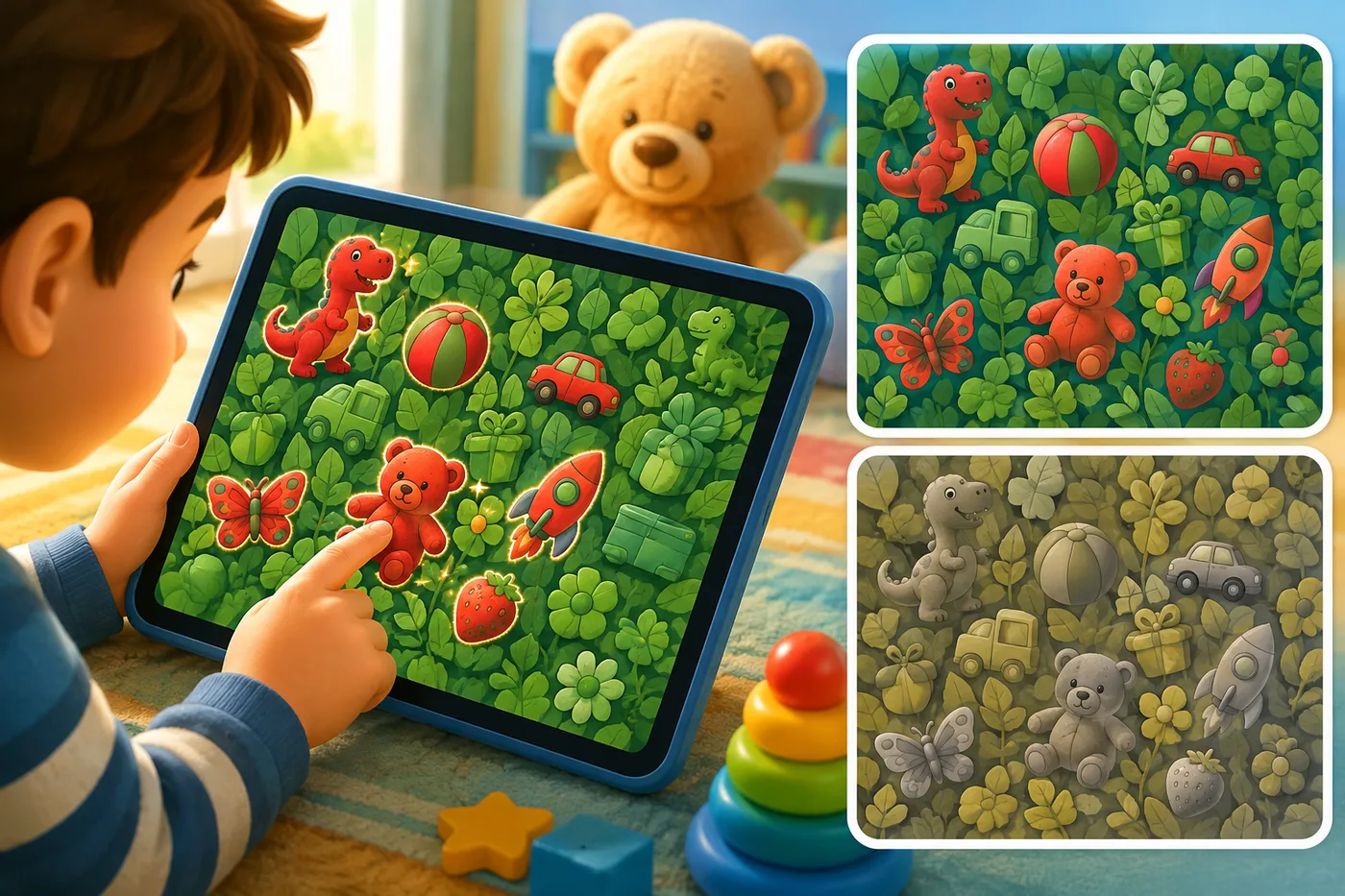
The Challenge
Children with congenital color vision deficiency, especially mild-to-moderate anomalous red-green differences where some color signal remains, can have trouble distinguishing colors in school, games, maps, charts, art activities, and everyday sorting tasks. The child may see the object, but the color cue that classmates use instantly is unreliable.
Current approaches mostly focus on screening, diagnosis, classroom or environmental adaptations, and color-filtering glasses or lenses. This challenge is explicitly experimental: perceptual training has not yet been shown directly to improve congenital color vision deficiency in children, and a game cannot restore a missing cone channel. Early evidence for chromatic perceptual learning and neural adaptation in anomalous trichromats makes this a useful research question, not an established treatment claim.
The Big Idea
Can an adaptive hidden-object game personalize color contrast while also serving as a research platform to measure whether children with remaining color-discrimination signal can improve on trained tasks, learn compensatory strategies, and transfer gains beyond the game?
What a Jam Prototype Could Be
- A hidden-object game that calibrates difficulty to a child's color-vision profile.
- Existing exercise concepts translated into play: repeated color matching, odd-one-out detection, shade ordering, figure-ground search, and adaptive discrimination between near colors.
- Levels that gradually reduce contrast between target and background, add distractors, or shift the same task into school-like contexts such as maps, lab materials, or toy sorting.
- A screening mode that estimates which color pairs are hard for the player, then builds a training ladder from easier to harder pairs.
- A progress view showing whether the child improves on specific discriminations without claiming to cure color blindness.
- A research mode that measures color-discrimination thresholds before and after training, then tests untrained colors or real-world tasks to look for transfer.
Design Questions
- Which color pairs should be tested first?
- How can the prototype avoid pretending to cure color blindness?
- Which untrained tasks could show whether any improvement transfers beyond the game?
- How can the game stay fun when the target is deliberately hard to see?
What This Is Not
- Not a diagnosis tool, treatment order, or replacement for clinical judgment.
- Not a place to use identifiable patient data.
- Not expected to be a finished hospital product after 30 hours.
Why This Matters
A prototype could test an open clinical question while creating a careful way to measure thresholds, learning, and transfer without assuming the intervention already works.