Gesture-Controlled Rehab for Wrist Pain
De Quervain's Tenosynovitis & Home Physiotherapy
The Challenge
De Quervain's tenosynovitis is a painful repetitive-strain condition affecting the tendons around the thumb and wrist. Patients are often given home exercises, splints, or physiotherapy plans, but the exercises can feel tedious, hard to track, and easy to abandon.
For patients, the difficult part is not only knowing what to do. It is doing the movements correctly, consistently, and without overdoing it. For clinicians, it can be hard to know whether exercises are being performed between visits.
The game-jam opportunity is to turn medically reviewed wrist and thumb movements into game input, so rehabilitation practice can become more engaging, measurable, and motivating.
The Game Proposal
What if the solution to repetitive strain was your favorite new game?
This project proposes a game controlled entirely through hand gestures tracked by a smartphone or PC webcam. Instead of pressing buttons or keys, players perform the exact physiotherapy movements needed for wrist rehabilitation, once those movements are confirmed by a doctor, physiotherapist, or hand therapist.
Guy has already built a Godot proof of concept, playable on PC and Android, that handles the hardest technical hurdle: capturing real-time hand and finger-tracking data via a webcam or smartphone camera and translating those gestures into engine inputs.
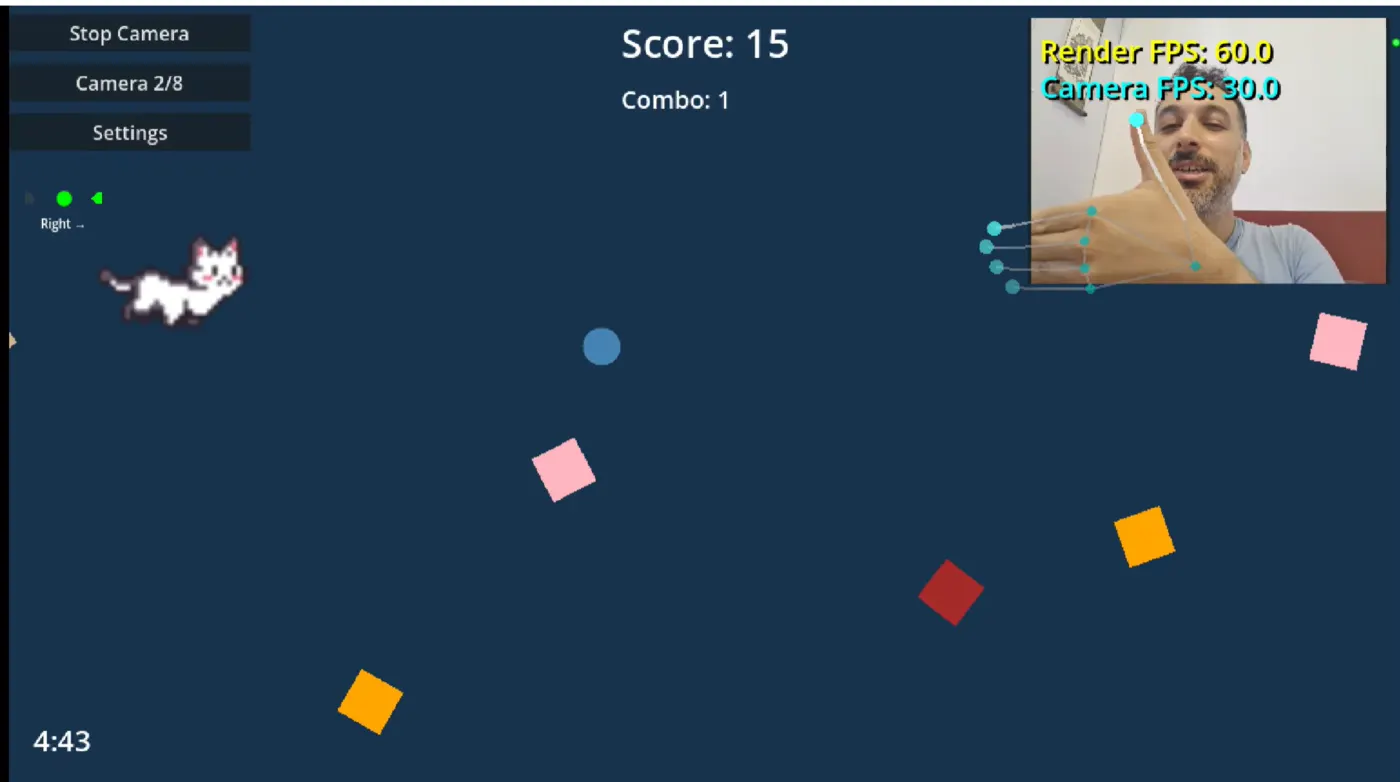
The demo already maps movement into a simple playable interaction. The jam opportunity is to take this working input system and build the actual game around it, making the core loop fun, visually rewarding, and clinically grounded.
Core Design Questions
- Movement as input: How can wrist, thumb, and hand motions become clear, responsive game controls?
- Motivation without overuse: How can a game encourage practice while avoiding pressure to do too much?
- Clinical fit: What feedback would help a patient practice correctly, and what data would be useful for a therapist?
What a Jam Prototype Could Be
- A short playable game controlled by webcam-tracked hand or wrist gestures
- A calibration flow that adapts to a player's range of motion
- Visual feedback that rewards smooth, controlled movement rather than speed or force
- A simple therapist-facing view showing practice sessions, completion, or movement quality
- A prototype that starts from Guy's existing Godot input system and focuses the jam work on game feel, feedback, and clinical framing
What This Is Not
This is not expected to become a finished medical device during the jam. The goal is to prototype a playable, useful interaction and explore whether game mechanics can make home physiotherapy more engaging and easier to follow.
Any specific rehabilitation protocol should be reviewed by a qualified medical professional before use with patients.
Extra Points For...
- Making the movement feel like part of the game, not like a disguised worksheet
- Supporting short, repeatable sessions
- Giving feedback that is encouraging rather than punitive
- Designing for both phone and desktop use
- Making the prototype easy for a physiotherapist or hand therapist to evaluate
Why This Matters
Home exercises are often where rehabilitation succeeds or fails. A well-designed game could help patients practice more consistently, give clinicians better insight into adherence and movement quality, and make repetitive recovery work feel less like a chore.