Functional Vision for Driving Safety
Ophthalmology, Functional Vision & Driving Safety
Attending Glaucoma Specialist
Head of The Goldschleger Authority for Research & Innovation, The Goldschleger Eye Institute, Sheba Medical Center
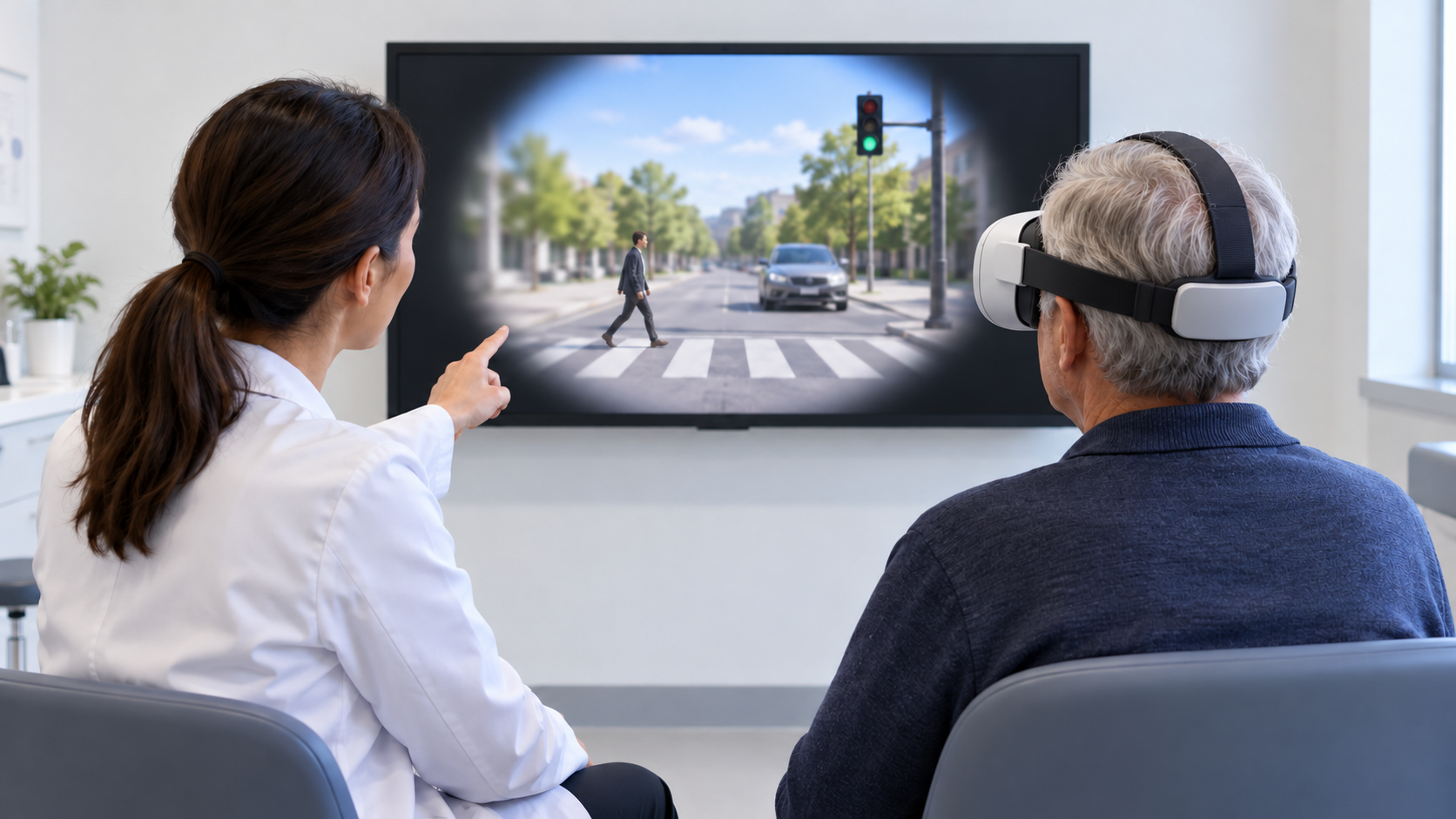
The Challenge
Many eye tests measure one narrow part of vision, such as visual acuity, contrast sensitivity, color vision, or visual field. Those tests are useful, but they do not show whether a person can safely interpret a dynamic driving environment.
Patients with cataract, glaucoma, macular degeneration, diabetic retinopathy, optic neuropathy, corneal opacity, or other eye conditions may need to detect pedestrians and obstacles, respond to sudden hazards, and divide attention while driving. Current licensing measures have been poor predictors of whether someone can drive safely.
The Big Idea
Can an immersive driving simulation measure functional vision more objectively by testing how a person detects and responds to safety-critical events?
Possible Directions
- A short immersive driving scenario, preferably in VR, built around one or two safety-critical events.
- Concrete stimuli such as a child suddenly entering the road, another pedestrian or obstacle appearing, or a phone call dividing the driver's attention.
- A scoring system that tracks detection time, missed hazards, collisions or near misses, braking response, gaze behavior, and navigation errors.
- An optional eye-tracking layer, or simulated blur, reduced contrast, field loss, glare, or peripheral-vision difficulty, if a team has suitable hardware and time.
- If a full VR build is too large, a headset-ready or screen-based prototype could mock the core immersive interaction and measurement loop.
- A clinician-facing report that summarizes what was difficult, not just whether the player completed the drive.
Design Questions
- Which one or two driving hazards should a prototype test first?
- What counts as a clinically useful response measure: reaction time, braking, gaze behavior, missed hazards, or another signal?
- Which patient groups or visual deficits should be represented first?
- How can the prototype stay immersive if a team can only mock part of the VR experience?
- What would make the result useful to a clinician rather than just an interesting game score?
What This Is Not
- Not a driving-license decision tool.
- Not a diagnosis tool or replacement for ophthalmology testing.
- Not a place to use identifiable patient data.
Why This Matters
A driving-focused functional-vision prototype could help clinicians and patients understand how eye disease affects safety-critical behavior, not only chart performance.