Infection Prevention Training Game
Hand Hygiene, PPE, Isolation Precautions & Hospital Infection Control
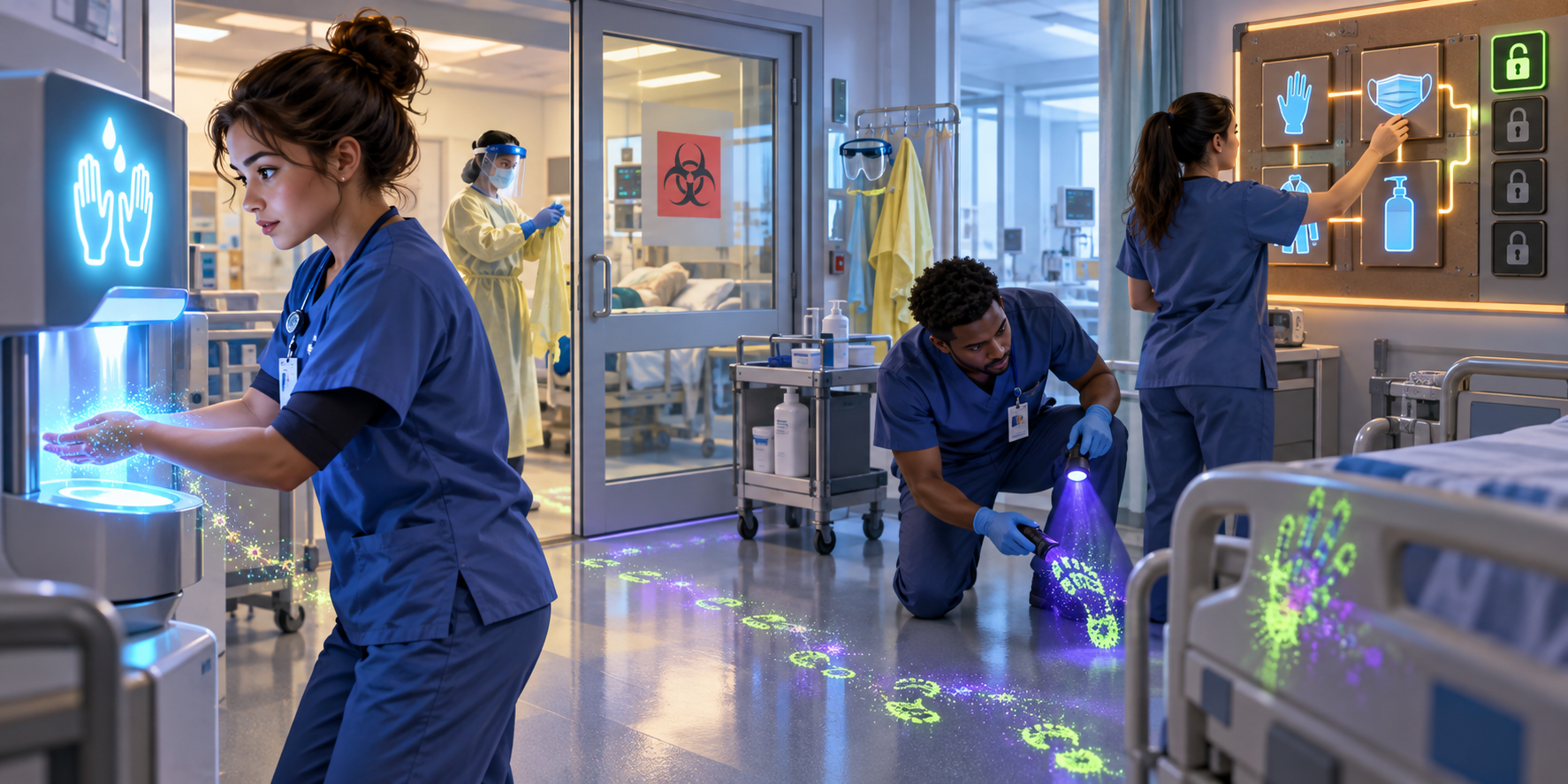
The Challenge
Hospital-acquired infections affect every age group, from premature infants to geriatric patients. Prevention depends on repeated decisions by physicians, nurses, cleaning and transport teams, and other hospital staff: hand hygiene, PPE, isolation precautions, line and dressing care, sterile technique, environmental cleaning, and recognizing when contamination may have spread.
Reported hand-hygiene compliance can remain around 50-80%, leaving a large gap between knowing the rules and performing them consistently in a busy ward.
Posters, lectures, videos, and mandatory online modules are easy to ignore and difficult to connect to ambiguous real-world situations. Direct observation can feel judgmental or punitive. Physical escape rooms can be memorable, but they require space, facilitators, resets, and continual updates; annual PPE training for dozens of staff is difficult to scale.
The difficult moments are often embedded inside a sequence of care. Cleaning hands when entering or leaving a room may be obvious, but staff must also recognize when to clean their hands between activities, when gloves have become contaminated, and when gloves must be removed and replaced. Gloves never replace hand hygiene.
PPE decisions add another layer: staff must recognize when gloves, masks, or gowns are indicated, choose the right combination, and put them on and remove them in an order that avoids self-contamination.
The Big Idea
Can a fast, replayable experience help hospital staff notice infection risks and practice hand-hygiene and PPE decisions inside a realistic sequence of care, with immediate, non-blaming feedback?
What a Jam Prototype Could Be
- A hidden-object / spot-the-risk mode where players search a room or patient-care scene for contamination risks and missed hand-hygiene moments.
- An escape-room, timed scenario, or puzzle format where each correct infection-prevention action unlocks the next step.
- A sequence of care in which players must identify hand-hygiene moments between activities, not only when entering and leaving the room.
- PPE decisions that ask when gloves, masks, or gowns are needed, how to put them on and remove them safely, and when contaminated gloves must be changed.
- Immediate feedback that makes contamination pathways visible and reinforces that gloves are not a substitute for hand hygiene.
Clinical reference: hand-hygiene sequence video shared by the infection-prevention team.
How Success Could Be Measured
- Recognition of risks and correct action selection.
- Fewer missed hand-hygiene, PPE, or isolation steps.
- Decision speed, confidence, and retention on a later replay.
- Correct selection, sequencing, donning, and removal of PPE.
Design Questions
- Which staff role and care sequence would expose the most important hand-hygiene and PPE decisions?
- Which mechanic best matches the teaching goal: hidden-object search, escape room, timed scenario, checklist race, or something else?
- How should the game give feedback without making staff feel blamed or judged?
- Which existing physical escape-room examples can be translated without locking the team into one mechanic?
What This Is Not
- Not a replacement for formal infection-control training or hospital policy.
- Not a blame or surveillance tool for individual staff.
- Not a place to use identifiable patient or staff data.
Why This Matters
If a game can make invisible contamination risks visible and repeatable, it could turn infection-prevention rules into practiced decisions instead of passive reminders.