Inside the Human Body: Anatomy and Immunology
Anatomy, Immunology & Medical Education
The Challenge
Anatomy and medical science are still often taught through textbooks, videos, static diagrams, and memorization. These tools can name structures, but they give students fewer opportunities to build a three-dimensional mental model, understand spatial relationships, or actively manipulate connected biological systems.
This challenge combines two complementary needs: helping students learn descriptive and spatial anatomy more actively, and letting them explore physiology and immunology from inside the body. A team should choose one learner group and one body system for the first prototype rather than attempting a complete anatomy curriculum.
The Big Idea
Can students enter an explorable human-body environment, identify structures and relationships, and make decisions that show they understand how anatomy and biological processes work together?
What a Jam Prototype Could Be
- A focused journey through one organ, anatomical region, or body system.
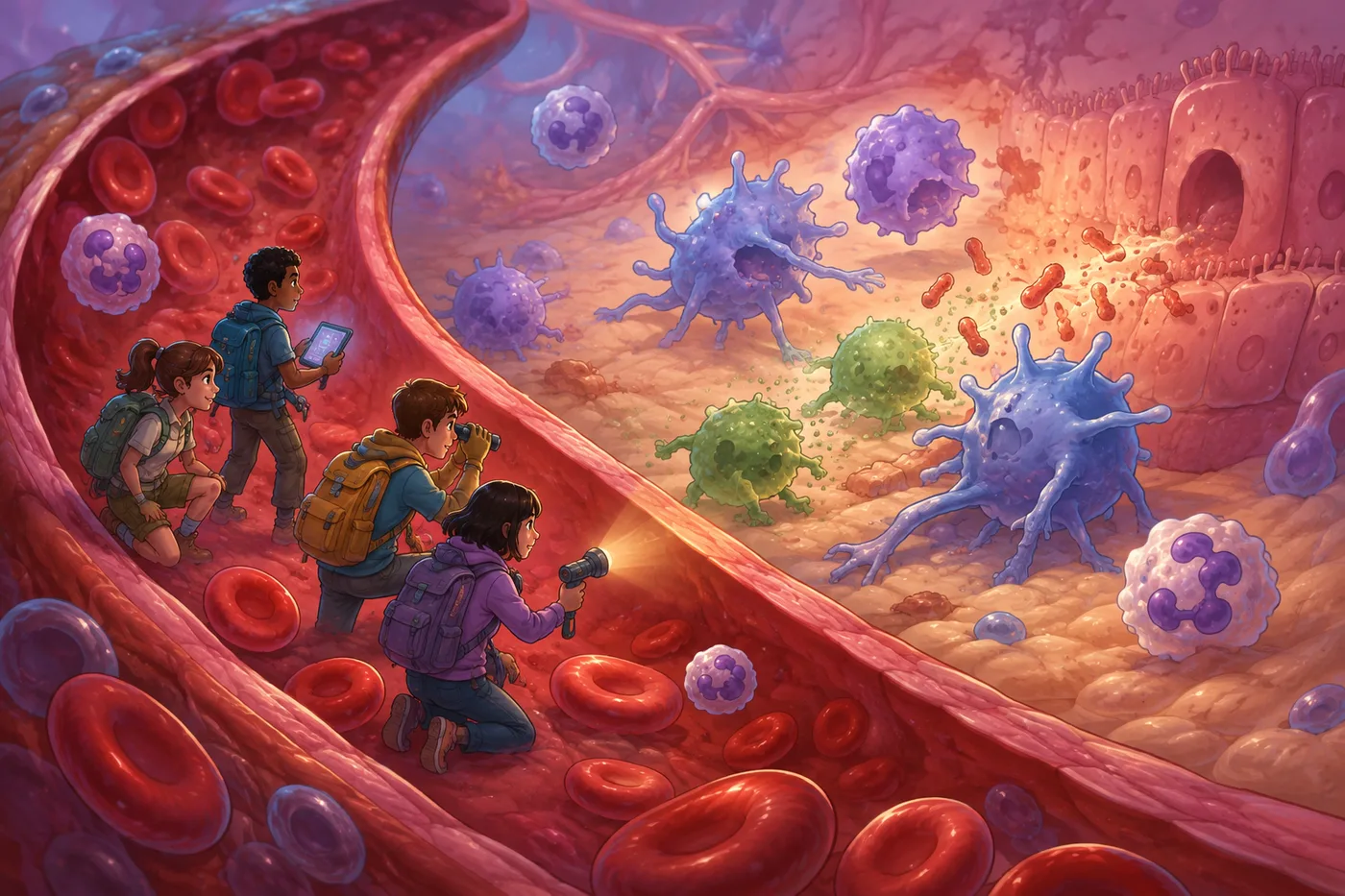
- An immune-system module in which students follow immune cells, activate antibodies, respond to an infection, and observe inflammation and downstream consequences.
- Spatial challenges that ask students to identify structures, trace pathways, orient themselves, or connect an MRI-style cross section with a three-dimensional body map.
- Short scenarios that require application, not just recognition: choose a response, predict what happens next, and see the consequences.
- Immediate corrective feedback and repeated challenges that measure whether learners become more accurate and efficient.
Design Questions
- Who should the first prototype serve: high-school students, medical students, imaging students, or another defined group?
- Should the first playable slice focus on the immune system, an anatomical region, or imaging-based spatial orientation?
- What should learners be able to do after playing that they could not do before?
- Which pre/post knowledge question, spatial task, or clinical scenario could measure improvement?
- How can the experience remain scientifically accurate without becoming a full curriculum?
What This Is Not
- Not a complete anatomy or biology course.
- Not a substitute for supervised clinical, laboratory, or school instruction.
- Not a place to use identifiable patient data.
Why This Matters
A focused, interactive body-system prototype could help learners build spatial understanding and apply concepts through decisions and consequences, while giving educators a measurable view of what students understand.