Balancing a Knee Replacement
Orthopedic Surgery, Biomechanics & Surgical Training
The Challenge
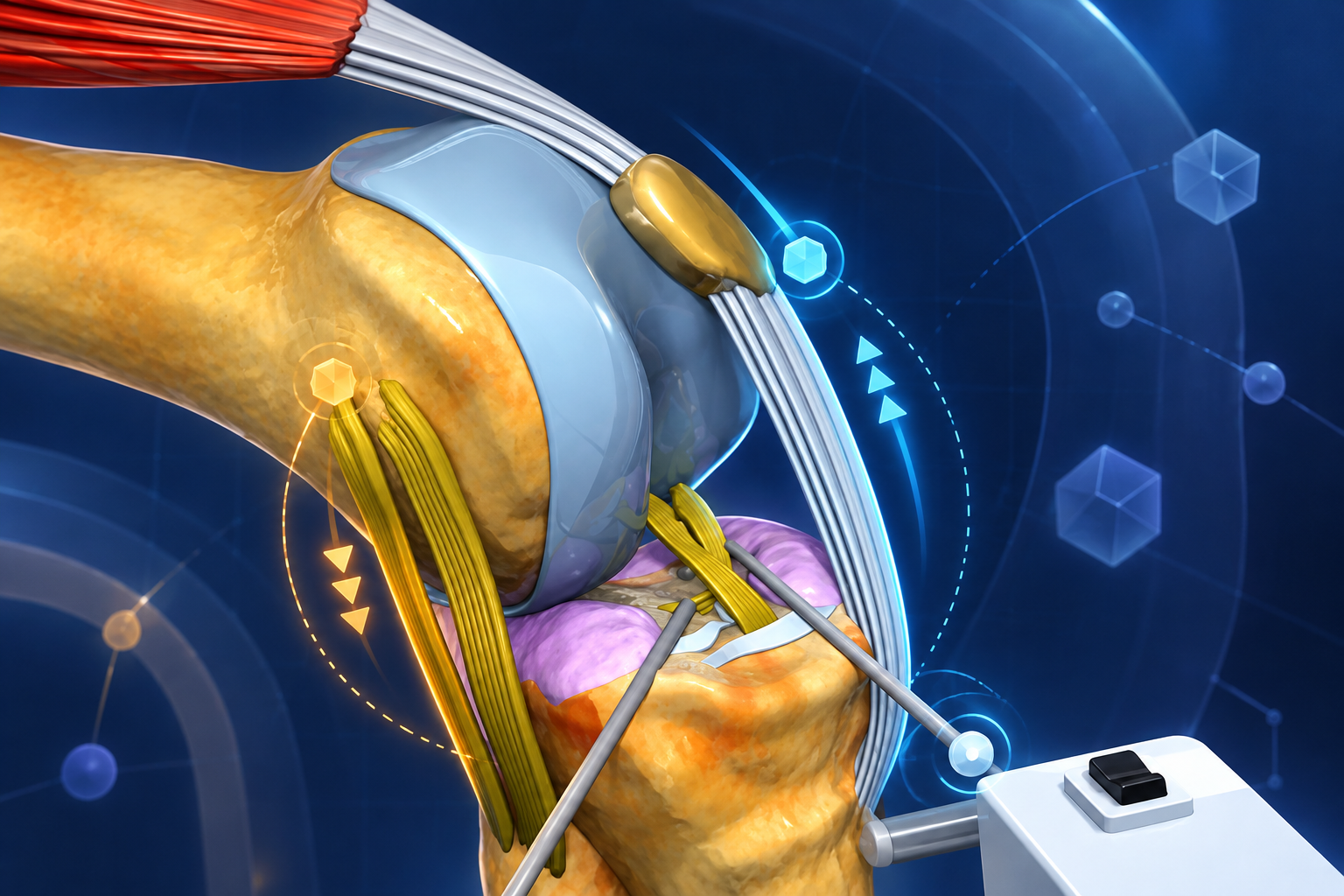
Replacing the damaged surfaces of a knee is only part of total knee replacement. The reconstructed joint must also be stable and appropriately tensioned as it moves from full extension into flexion. Surgeons assess the spaces between the femur and tibia, the tension of the supporting ligaments, limb alignment, component size and position, and how all of these factors change through the knee's range of motion.
These decisions interact. A bone cut, change in implant position or rotation, insert choice, or selective soft-tissue release may improve one part of the motion while creating tightness, laxity, asymmetry, joint-line change, or altered tracking somewhere else. An overly tight knee may lose motion; a loose or uneven knee may remain unstable or painful.
Rotation is especially important. Femoral and tibial components can appear acceptable in a static view yet be rotationally misaligned, affecting flexion balance, patellar tracking, stability, pain, and range of motion. Revision for component malrotation can substantially improve symptoms, which makes rotational reasoning an essential part of the training problem rather than a secondary detail.
Why It Is Difficult to Learn
Knee balancing combines three-dimensional anatomy, mechanics, tactile judgment, and a sequence of decisions whose effects are not always intuitive. Residents learn through teaching, surgical observation, models, and supervised operating, but real procedures do not offer a safe reset button for comparing several approaches to the same knee.
There is also no single uncontested recipe. Measured resection uses anatomical landmarks and planned bone resections to guide component position. Gap balancing tensions the joint after the tibial cut and uses the resulting spaces to help guide femoral rotation and resection. This can make the decision sequence more efficient, but it also makes the reliability of the tensioning and the condition of the soft tissues especially important. Hybrid methods and different alignment philosophies combine these inputs in different ways. A useful training experience should teach the consequences and tradeoffs without declaring one philosophy universally correct.
The Big Idea
Can knee-replacement balancing become a physics puzzle where surgical trainees explore how coupled changes to bone, implants, and soft tissues affect stability throughout motion?
Possible Directions
- Present a virtual knee with a particular deformity, anatomy, ligament pattern, and starting plan.
- Let the player inspect medial and lateral spaces in extension and flexion, apply controlled stress, and see how the joint behaves through motion.
- Allow selected adjustments to bone cuts, component size, femoral and tibial rotation, position, insert thickness, and soft-tissue tension, with each change affecting several measurements at once.
- Visualize consequences such as residual tightness or laxity, asymmetric gaps, joint-line change, instability, limited motion, component malrotation, or altered patellar tracking.
- Let learners compare the workflow of measured resection and gap balancing, including which information becomes available at each step and how an efficient sequence can still produce a poor result if its assumptions are wrong.
- Support more than one clinically defensible solution when different surgical philosophies can reach acceptable results.
- Progress from a straightforward knee to cases where correcting one imbalance creates another.
What Success Could Look Like
- The learner can explain how each adjustment changed the knee in both flexion and extension.
- The final construct remains stable through motion without unnecessary cuts or releases.
- The learner recognizes overstuffing, laxity, asymmetry, and other important failure patterns.
- The learner can identify how rotational errors may present through tracking, stability, pain, or restricted motion even when other measurements appear acceptable.
- The experience can compare reasoning and tradeoffs across accepted balancing philosophies rather than scoring only one hidden answer.
Clinical Questions to Resolve
- Which balancing variables and surgical actions are essential for a first teaching case?
- Which rotational landmarks and malrotation consequences should the first case represent?
- Should the first version teach one baseline philosophy or explicitly compare several approaches?
- Which failure patterns should residents learn to recognize first?
- What measurements, ranges, or reasoning would make a solution clinically acceptable?
- Should the primary learner be an orthopedic resident, an arthroplasty fellow, or another surgical trainee?
What This Is Not
- Not a surgical guide, operative planning system, or substitute for supervised training.
- Not a claim that one balancing or alignment philosophy is correct for every patient.
- Not a tool for making decisions about a real patient's operation without clinical validation.
Clinical References
- Surgical Techniques for Total Knee Arthroplasty: Measured Resection, Gap Balancing, and Hybrid
- The relevance of ligament balancing in total knee arthroplasty
- Revision total knee arthroplasty for component malrotation is highly beneficial: a case control study
- The Impact of a Gap Balancing or Measured Resection Surgical Technique on Posterior Condylar Offset and Patient-Reported Outcome Measures