XR Trainer for Microdirect Laryngoscopy
Otolaryngology / Surgical Skills / XR Training
The Challenge
Microdirect laryngoscopy is a technically demanding ENT procedure performed through a laryngoscope and surgical microscope. The surgeon works through a narrow, magnified field around delicate structures such as the vocal cords, without direct external visibility of the instruments or target tissue.
ENT residents, fellows, and other clinicians learning or maintaining microlaryngeal skills must coordinate both hands, judge depth through the microscope, control delicate instruments, follow the procedural sequence, and understand how tissue responds to manipulation. Repetition is limited before and during supervised operating-room exposure.
Why Current Tools Fall Short
Training relies on observation, supervised operating-room experience, anatomical models, cadaveric practice, and selected simulation systems. Operating-room practice is realistic but difficult to repeat and requires close supervision. Cadaveric training is valuable but expensive, resource-intensive, and not continuously available. Physical models can support practice but often have limited anatomical and tissue realism.
Observation and video do not reproduce binocular depth, a fixed microscope position, restricted access, two-handed instrument coordination, instrument collisions, or the response of healthy and abnormal tissue to manipulation.
Possible Directions
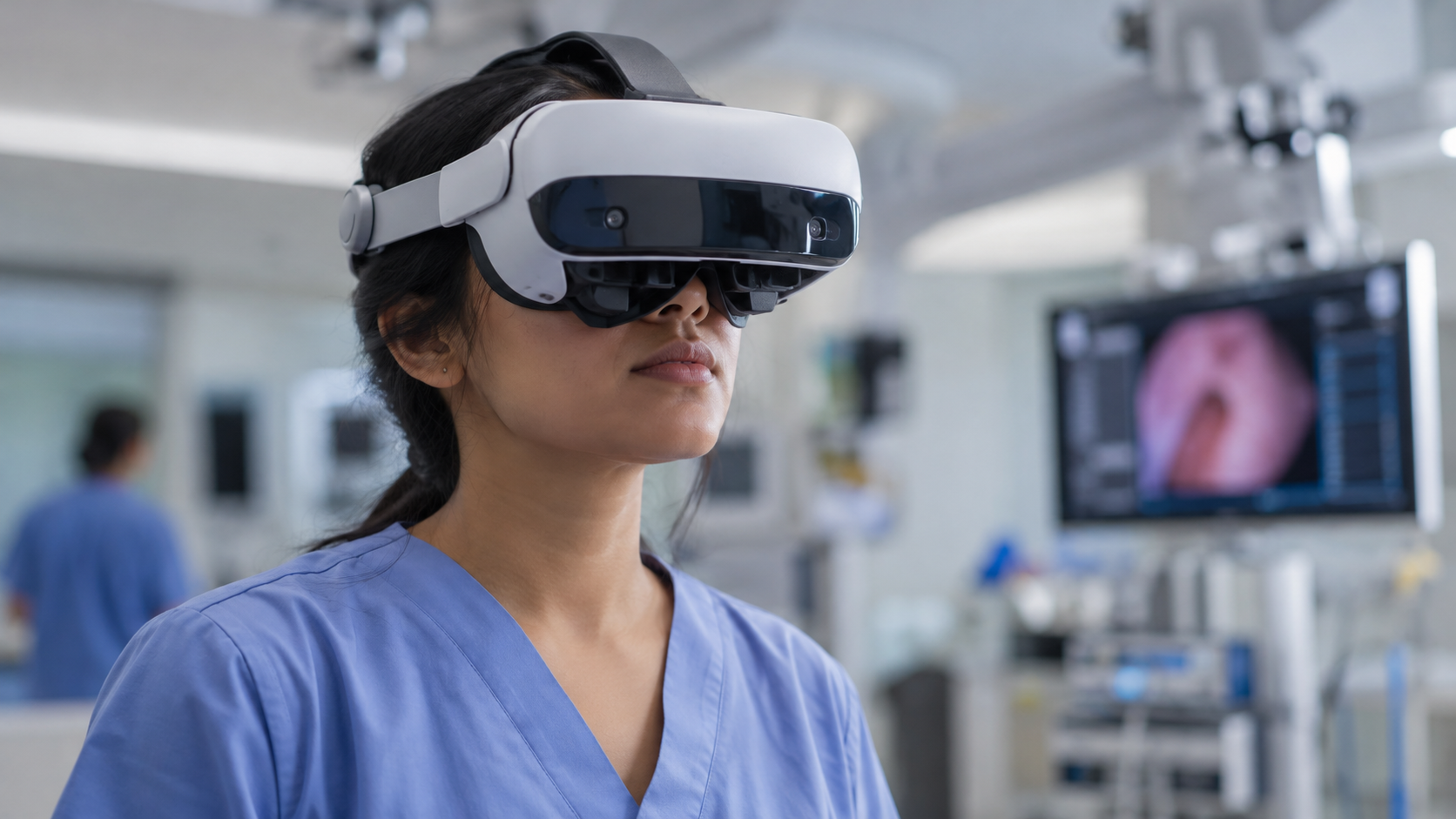
One possible direction is an XR simulation with the headset or viewpoint fixed to reproduce looking through a surgical microscope. The right and left tracked controllers could represent two microsurgical instruments, such as a microscopic knife and forceps.
A complete interaction could ask the trainee to inspect the vocal cords, identify a vocal-cord polyp, stabilize or tension tissue with the forceps, approach and manipulate it with the knife, remove the lesion, and finish while minimizing contact with healthy surrounding tissue.
The simulation could track each procedural step and provide immediate visual or haptic feedback on instrument path, precision, stability, unsafe angles, excessive force, collisions, tissue interaction, and unintended healthy-tissue contact. Repeated sessions could introduce progressively more difficult anatomy or lesions once the core interaction works.
What Success Could Look Like
- More accurate targeting and steadier two-handed instrument control.
- Fewer collisions, procedural errors, and unintended contacts with healthy tissue.
- Correct completion of the inspection, identification, manipulation, and removal sequence.
- Improved completion time and an objective performance score across repeated sessions.
- Greater familiarity, coordination, and confidence before supervised operating-room practice.
Clinical Boundaries
This would be a practice environment, not validation for independent surgery. Its anatomy, instrument behavior, protected structures, and performance feedback would require review by experienced laryngology and simulation specialists.