Making Choking Training Feel Real
MSR Simulation & Emergency Response Training
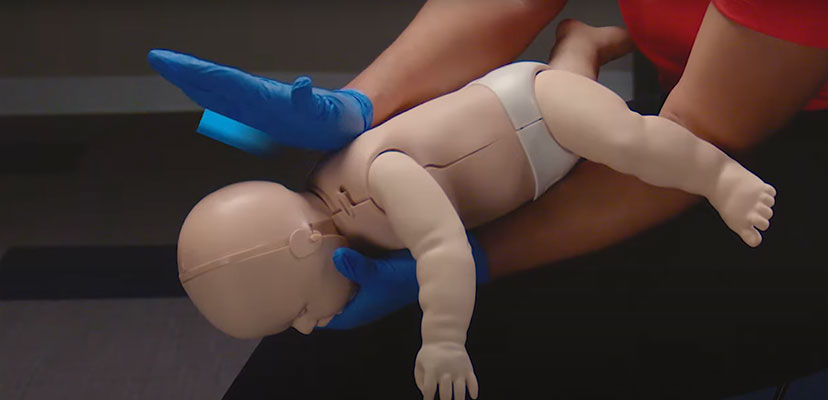
The Challenge
Heimlich maneuver training for adults and infants can be hard to teach in a way that feels real.
When instructors teach the Heimlich maneuver for adults or infants, practice often happens on a mannequin. The adult and infant procedures are different, but both are referred to as Heimlich maneuver training in this context. The mannequin is useful for learning hand placement and sequence, but it does not behave like a person in distress.
The result:
- The training can feel boring or artificial.
- Learners do not see realistic signs of choking or distress.
- The mannequin does not clearly react to what the learner does.
- The mannequin should respond only when the maneuver is done correctly.
- It is hard to know whether the action was performed correctly.
- Instructors have to supply most of the realism, urgency, and feedback themselves.
This is a simulation problem and a feedback problem.
The Big Idea
Can a game or interactive simulation make Heimlich maneuver training feel urgent, observable, and measurable, without needing a fully realistic human simulator?
A strong prototype could turn a standard mannequin, screen, tablet, or sensor setup into a more convincing training scenario.
What The Game Should Help Teach
The goal is not to replace certified instruction. The goal is to make practice more engaging and give better feedback during training.
1. Recognizing Distress
Learners should understand what choking can look like before the intervention begins.
- Visible signs of distress.
- Urgency without panic.
- Clear differences between partial obstruction, full obstruction, and recovery states, if clinically appropriate.
- Separate framing for adult and infant scenarios.
2. Performing The Action Correctly
The experience should help learners practice correct sequence, force, placement, rhythm, and decision-making.
- Was the learner in the right position?
- Did they perform the right action for the patient type?
- Was the action too weak, too strong, too slow, or misplaced?
- Did they check whether the person recovered?
3. Getting Useful Feedback
The most important feedback is the simulated patient's response. The mannequin or screen should show improvement only when the maneuver is done correctly.
- Simple pass/fail signals.
- Visual response from the simulated patient.
- Post-scenario review for instructor and learner.
- Clear explanation of what to improve next time.
Possible Prototype Directions
A. Screen-Based Scenario Layer
A tablet or monitor shows an adult or infant choking scenario while the learner practices on a mannequin.
- The patient changes state based on whether the maneuver was done correctly.
- The learner sees distress, worsening, improvement, or recovery.
- The instructor can trigger events during training.
B. Sensor-Assisted Mannequin Feedback
Add simple sensors to the mannequin or training surface.
- Pressure, force, or contact sensors.
- Placement feedback.
- Rhythm and sequence feedback.
- A simple visual display showing whether the action was in range.
- A patient response that appears only after a correct maneuver.
C. Instructor-Controlled Simulation Game
Give the instructor a control panel to make the scenario more dynamic.
- Adult or infant mode.
- Different levels of distress.
- Correct and incorrect response consequences.
- Replay or debrief after each attempt.
D. Team Training Mode
For advanced training, the game could include communication and role assignment.
- Who recognizes the emergency?
- Who calls for help?
- Who performs the intervention?
- How does the team stay calm and act quickly?
Jam Scope & Expectations
Teams do not need to build a full medical simulator during the jam.
Good 30-hour outcomes could include:
- A playable Heimlich maneuver training scenario.
- A prototype feedback system for mannequin practice.
- An instructor dashboard for triggering distress and recovery states.
- A simple adult/infant scenario comparison.
- A post-training debrief screen showing what went well and what to improve.
What This Is Not
- Not a replacement for certified CPR or choking-response instruction.
- Not medical advice for the public.
- Not a finished clinical training device.
- Not a substitute for instructor judgment.
All clinical content, especially infant choking response, should be reviewed by qualified instructors before public use.
Extra Points For...
- Clear feedback learners can understand immediately.
- Support for both adult and infant training scenarios.
- A setup that works with existing mannequins or low-cost equipment.
- Instructor controls that are simple enough to use during a class.
- Debrief tools that make the next attempt better.
Why This Matters
Choking response is a high-stakes skill. People need to act quickly, correctly, and calmly.
But if training feels fake, learners may not build the confidence or muscle memory they need.
This challenge asks game developers to make emergency-response practice feel more real, more responsive, and more useful, while keeping instructors in control.