Coping Skills Practice Game for Pediatric Procedures
Pediatrics / Procedure Preparation / Coping Skills
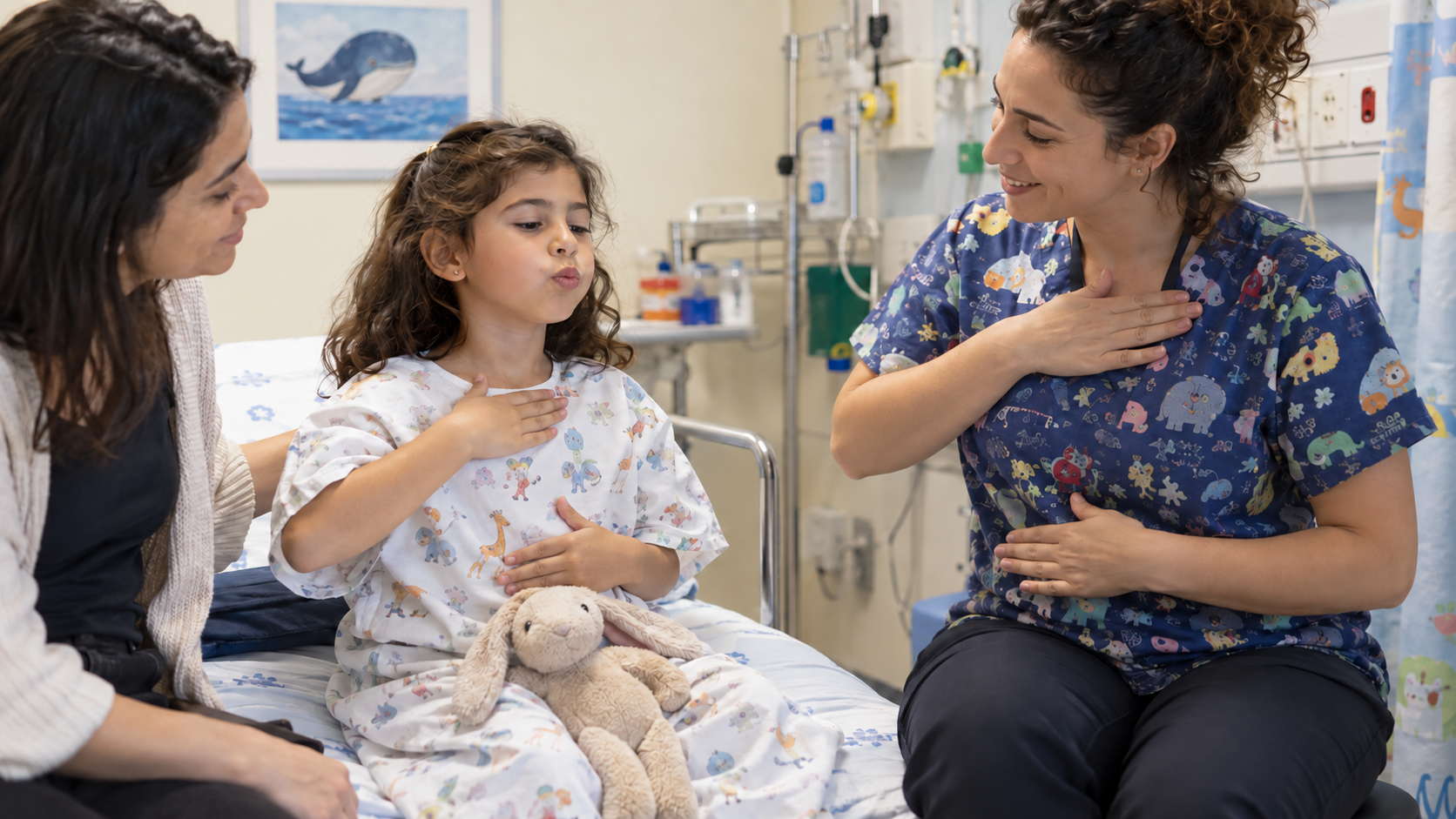
The Challenge
Needle sticks, IV insertions, imaging, and other procedures can trigger intense fear and panic in children ages 5-18, especially those receiving repeated treatment, living with chronic illness, or spending long periods in the hospital.
Educational and clinical teams may teach breathing, guided imagery, cognitive distraction, progressive muscle relaxation, focused visual distraction, or other coping techniques. Knowing a skill intellectually is not the same as being able to use it under acute stress. Trying a new technique for the first time during panic is often overwhelming and ineffective.
Why Current Tools Fall Short
Current support is usually verbal and adult-led, supplemented by video clips, standard distractions, or parental coaching. Children rarely get a safe chance to practice techniques before the procedure or experience mild, progressive stress while discovering which method works for them.
Without rehearsal, a child may be unable to retrieve a skill at the moment it is needed and may feel that they failed.
Possible Directions
One possible direction is a progressive, low-stakes simulation in which mild medical stressors become gradually more demanding and the child can pause or step back at any time.
The child could experiment with box breathing or other breath-control mechanics, guided imagery, counting, cognitive distraction, progressive muscle relaxation, music, and focused visual distraction. The experience could help them identify a personal “coping kit,” practice until the response becomes familiar, and share the preferred strategy with parents and staff before the real procedure.
An onboarding section could let the child choose a strategy, watch a short demonstration, and receive a simple age-appropriate explanation of what the technique is intended to do in the body.
Different age groups may need different settings. Younger children could practice in a neutral metaphorical world, such as guiding a spaceship through dense fog by using a chosen calming strategy. Teens could practice inside a realistic busy waiting room, zoom in on themselves, and select guided imagery, visual breathing, or an interactive 5-4-3-2-1 grounding exercise.
Feedback could include a calm meter and an environment that gradually becomes quieter and more organized as the child completes the chosen strategy. Guided imagery could allow the child to assemble a personal safe space by selecting a background, music, and supportive companions.
Optional physiological input such as heart rate could reflect recovery if suitable hardware and clinical interpretation are available, but should not be required.
What Success Could Look Like
- The child identifies which coping tools work best for them.
- The child independently initiates a chosen strategy during a real procedure.
- Lower panic, smoother cooperation, and greater perceived control.
- Completion of progressively harder practice levels and recovery after simulated stress.
- Optional heart-rate recovery when valid hardware is available.
Clinical Boundaries
Any simulated stress should be mild, adjustable, and immediately stoppable. The experience should reward practice and self-awareness rather than treating calmness as success or blaming a child who remains afraid.