Helping Children Through Eye Exams
Pediatric Ophthalmology, Retinoscopy & Fundus Examination
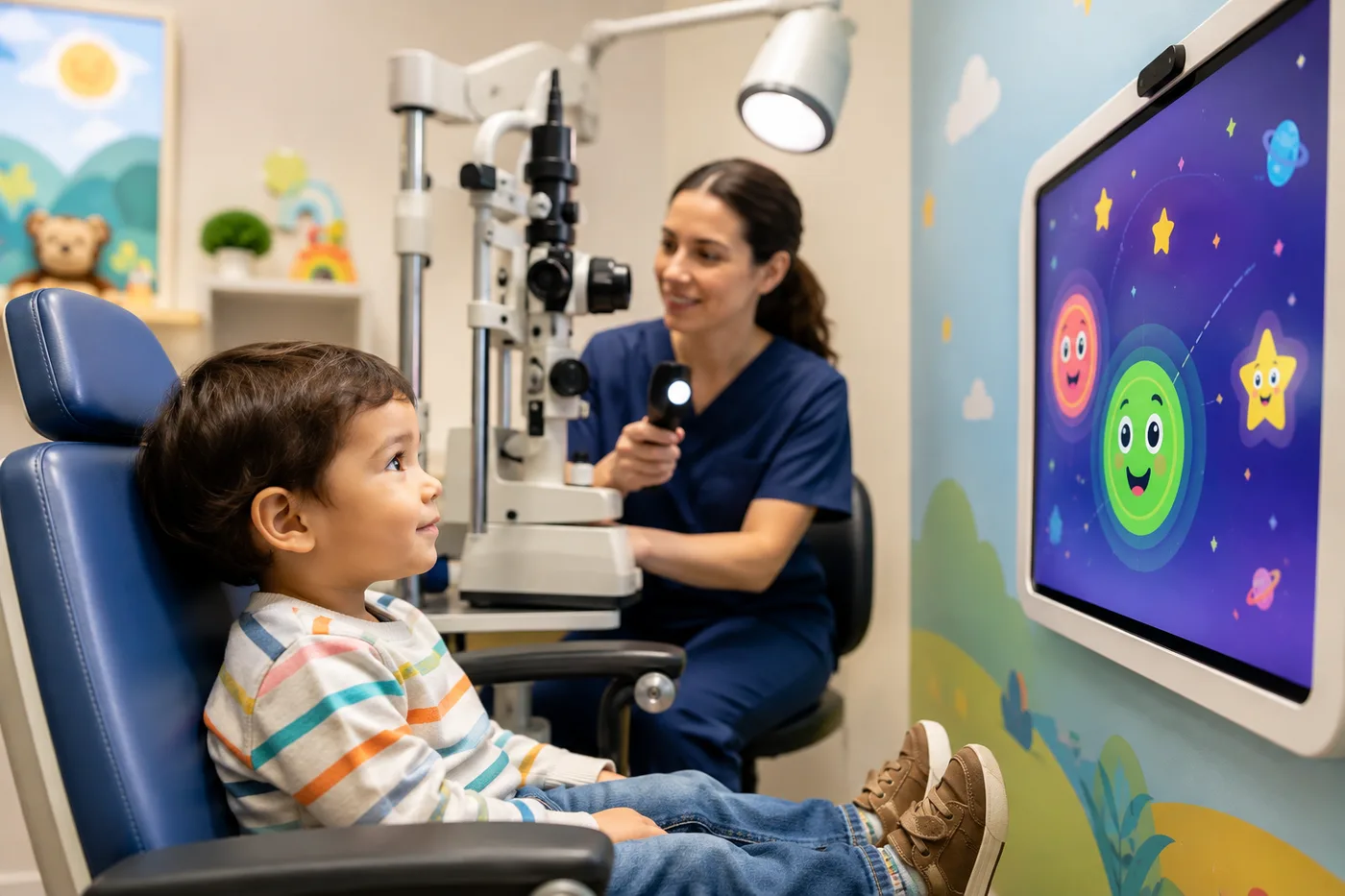
The Challenge
Retinoscopy and fundus exams are important, but young children, especially under about age 8, often struggle to cooperate. Their pupils may be dilated, bright light can cause glare and discomfort, and the child may blink, look away, squeeze their eyes shut, move their head, or become anxious around unfamiliar equipment.
Poor cooperation can result in clinical consequences such as less accurate refraction measurements and difficulty seeing the optic disc, macula, and retina clearly enough to spot fundus pathology.
The Big Idea
Can a game make the child naturally look where the clinician needs them to look, long enough for a better exam?
What a Jam Prototype Could Be
- A gaze-guidance layer that works alongside the clinic's existing screen, using game rewards or story moments to help the child keep looking where the ophthalmologist already directs them.
- A calm character or story that prepares the child for dilation, glare, bright light, and short periods of stillness.
- A child-facing visual or game, presented on whatever display or fixation target fits the specific exam, that rehearses the rhythm of looking at a target, holding fixation for a few seconds, resting or blinking, then looking again.
- A simple prototype tested with simulated exam timing, so teams can show the cooperation loop without needing to connect to clinical exam hardware.
Design Questions
- How can the game reward stillness and fixation without scolding?
- What visuals work when pupils are dilated and glare is uncomfortable?
- How short can each interaction be and still help the exam?
- How should the game fit around the clinic screen and fixation tools Sharon already uses, without requiring the child to use a tablet during the exam or distracting from the ophthalmologist's controls?
What This Is Not
- Not a diagnosis tool, treatment order, or replacement for clinical judgment.
- Not a place to use identifiable patient data.
- Not expected to be a finished hospital product after 30 hours.
Why This Matters
A child who can cooperate for a few more seconds may give the clinician a clearer view and a better measurement.