Motor-Imagery Gesture Game for Phantom Limb Pain
Amputee Rehabilitation, Mirror Therapy & Home Adherence
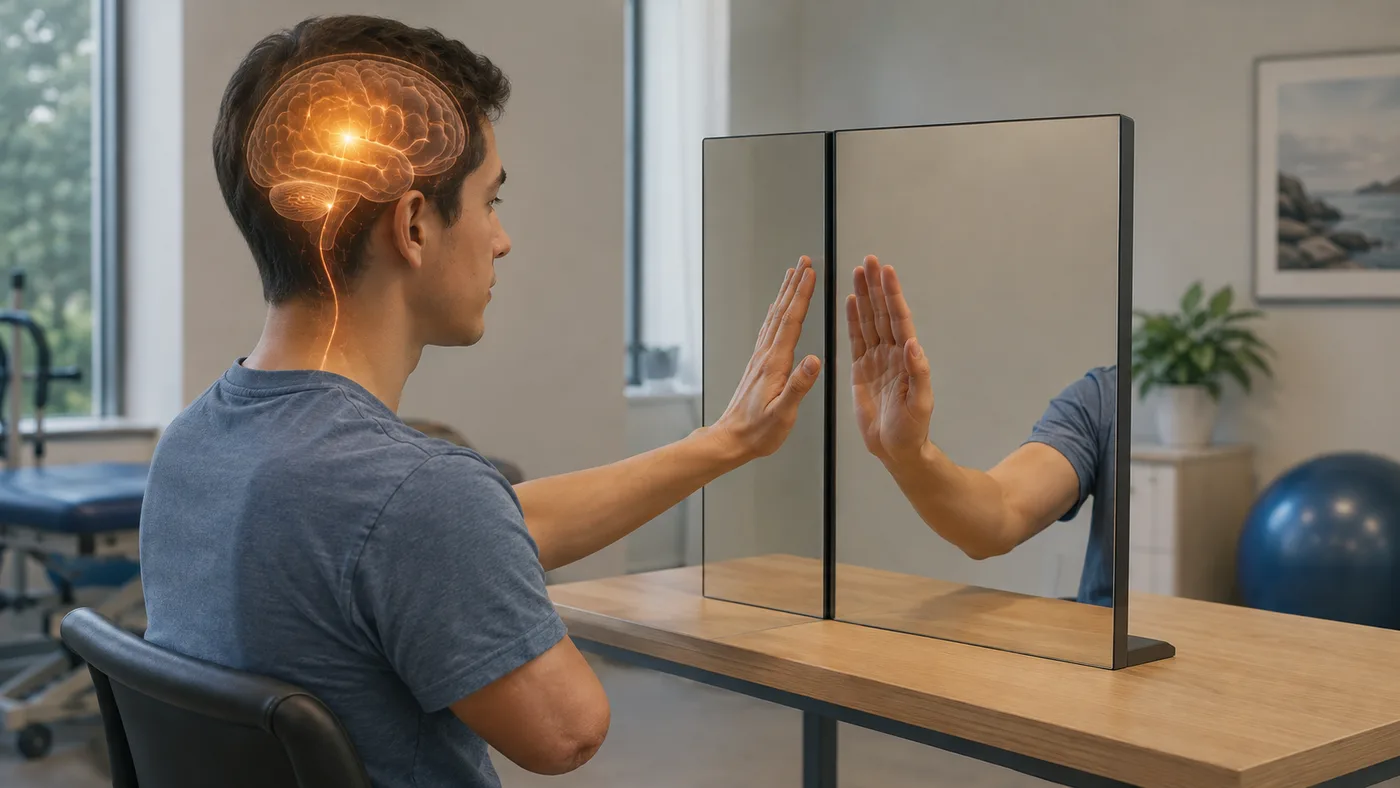
The Challenge
Phantom limb pain affects around 80% of amputees and becomes chronic in more than half. Medication often provides limited relief. For young traumatic and war-related amputees, the pain and treatment burden may last for decades.
Motor imagery asks a person to vividly imagine moving the missing limb. Mirror therapy then supplies matching visual feedback from the intact limb. In the proposed digital experience, the system first calibrates which limb is missing and at what level, since that determines which movements the game can ask for. The same principle applies to arms and legs: the requested movements must match the patient's amputation level, so the remaining anatomy can mirror the missing-limb movement convincingly.
The patient imagines the missing limb moving, then moves the intact hand, arm, foot, or leg in view of a camera. On a tablet or in a VR headset, that live movement appears on the missing-limb side, so raising the right hand can look like raising the left. Game targets then arrive on the missing-limb side, and the patient reaches, opens or closes the hand, bends a knee, or makes another calibrated movement with the intact limb while seeing the mirrored limb complete the action.
The Big Idea
Can mirror therapy become a playable, daily gesture game where the intact limb drives a convincing missing-limb interaction?
What a Jam Prototype Could Be
- A camera-based tablet or VR prototype where movement of the intact hand, arm, foot, or leg controls a live mirrored representation on the missing-limb side.
- A calibration step for upper- or lower-limb loss and different amputation levels, so the game only asks for movements the remaining anatomy can mirror.
- Upper-limb tasks such as opening and closing a hand, rotating a wrist, reaching, grasping, or moving virtual objects.
- Lower-limb tasks such as moving the foot up and down at the ankle, rotating the ankle, curling and spreading the toes, and bending or straightening the knee, selected according to amputation level.
- A clear sequence: calibrate the limb and movement range; cue the patient to imagine the missing-limb action; track the matching intact-limb gesture; display it immediately on the missing-limb side; then let the mirrored limb hit, reach, or manipulate a target.
- A daily streak and difficulty-scaling loop that rewards consistent practice.
- A lightweight clinician view logging session frequency, duration, completed movement sets, self-reported pain before and after, and intact-limb movement range without collecting video by default.
Design Questions
- Which limb and amputation level should the first prototype support?
- How should lower-limb mirror tasks differ from hand or arm tasks?
- How can the game stay therapeutic without feeling like homework?
- What should be tracked quietly as useful clinical data?
- How can the system avoid mismatched or anatomically implausible feedback that breaks the illusion?
What This Is Not
- Not a diagnosis tool, treatment order, or replacement for clinical judgment.
- Not a place to use identifiable patient data.
- Not expected to be a finished hospital product after 30 hours.
Why This Matters
A game that makes practice tolerable and repeatable could turn a known therapy into something patients actually use.