Objective Tremor Measurement Through Gameplay
Movement Disorders, MRgFUS & Quantitative Assessment
The Challenge
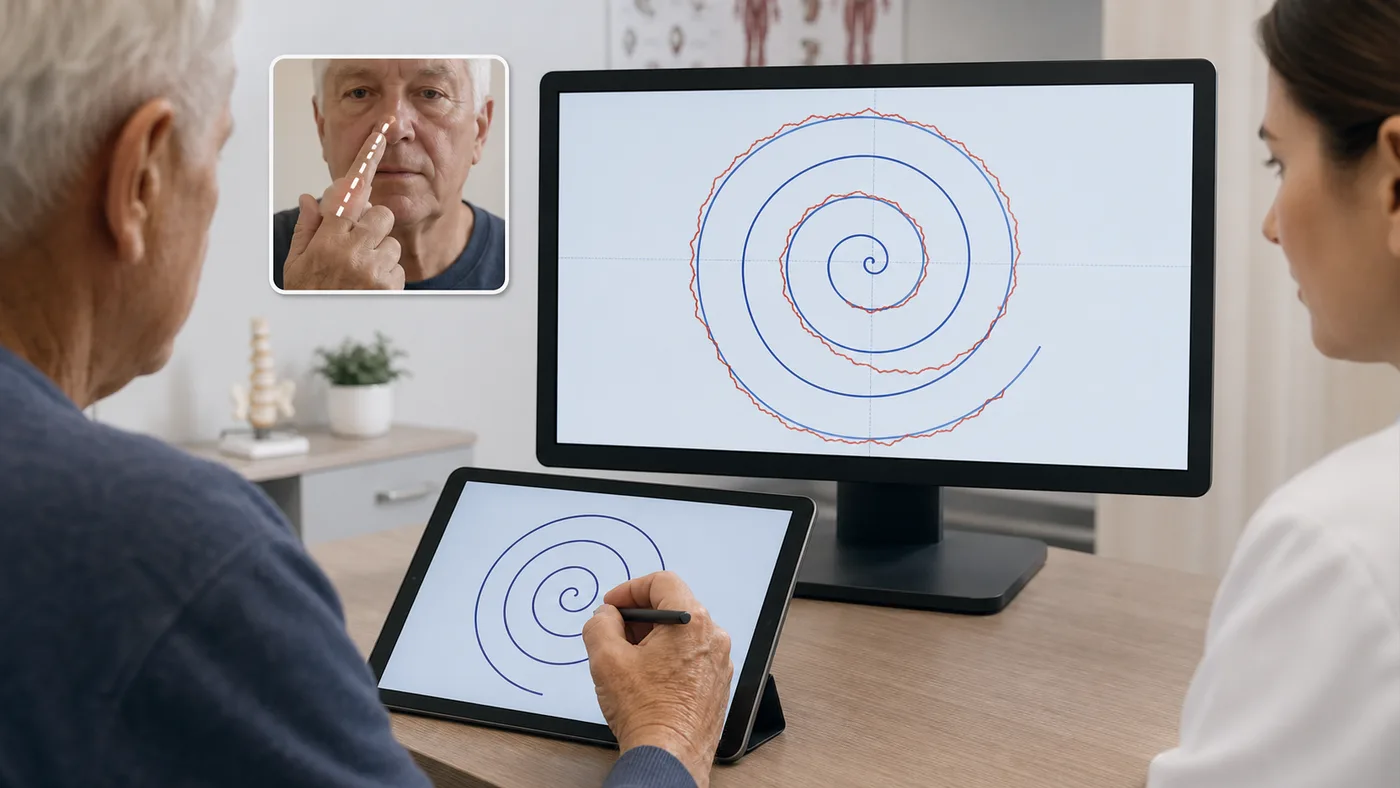
Essential tremor is still commonly assessed by asking a patient to draw an Archimedes spiral, write a standard sentence, hold a posture, or perform a finger-to-nose task while a clinician rates the result. These checks are fast and useful, but visual scoring can be coarse, vary between raters, and miss small changes.
During MR-guided focused ultrasound (MRgFUS) thalamotomy, the stakes are higher. The same score needs to be captured before surgery, during the procedure in the magnet, and after surgery. Pre- and post-procedure checks happen outside the magnet room. The intra-procedural check happens inside the magnet, with MR-safety restrictions, the patient's head fixed, and limited access to the hands.
The assessment supports the decision to raise the temperature by helping confirm whether the target coordinates are correct before an irreversible lesion is made. The task must be quick, repeatable, comparable with baseline, and usable across all three settings.
This environment defines the input challenge. The patient cannot use an ordinary phone, tablet, touchscreen, metal pen, or consumer controller in the magnet room. A plausible prototype could use an MR-safe handheld input device, such as a joystick or trackball, with a simple "hold the cursor steady" or "trace the path" task. A camera from the control room can complement the measurement, but should not be the primary input.
The Big Idea
Can one simple MR-safe interaction produce an objective tremor score across baseline, intra-procedure checks inside the MRI environment, and post-procedure confirmation?
What a Jam Prototype Could Be
- One task used at three moments on the same scale: pre-procedure baseline, intra-procedural assessment before the decision to raise the temperature, and post-procedure confirmation.
- An MR-safe input concept, such as a joystick or trackball, that can support a "hold the cursor steady," "trace the path," or similar task in all three settings.
- A full visual version for pre- and post-procedure assessments, with a simplified in-magnet version that can still work if the patient cannot see a screen inside the bore.
- Optional camera capture from the scanner control room as a complementary signal, not the primary interaction.
- Objective output such as tremor amplitude and frequency, path deviation, completion time, target hits, overshoot, movement variability, and change from that patient's baseline.
- A seconds-long assessment loop designed for a patient whose head is fixed and whose hand access may be limited.
- A simulated dataset showing how scores might change across baseline, intra-procedure checks, and post-procedure confirmation.
Design Questions
- Which task is fastest and least tiring for a patient with fixed head position?
- What MR-safe input device could work consistently before, during, and after the procedure?
- How can the in-magnet version still work if the patient cannot see a screen inside the bore?
- What visualization helps the team make the decision to raise the temperature quickly?
- How should the prototype communicate uncertainty?
- Can it remain sensitive to small improvements without encouraging speed or movement that adds noise?
What This Is Not
- Not an approved intra-procedural decision tool.
- Not a replacement for neurologist or neurosurgical judgment.
- Not a hardware procurement recommendation.
- Not a design that assumes the patient can hold an ordinary tablet, phone, controller, or metal stylus in the MRI environment.
- Not a claim that low-temperature checks prove treatment effect; they help confirm target coordinates.
Why This Matters
Even a prototype could clarify how game-like tasks might turn subjective tremor checks into repeatable data at a critical decision point.