Making Vestibular Exams Fun for Kids
ENT, Balance Disorders & Eye-Tracking Cooperation
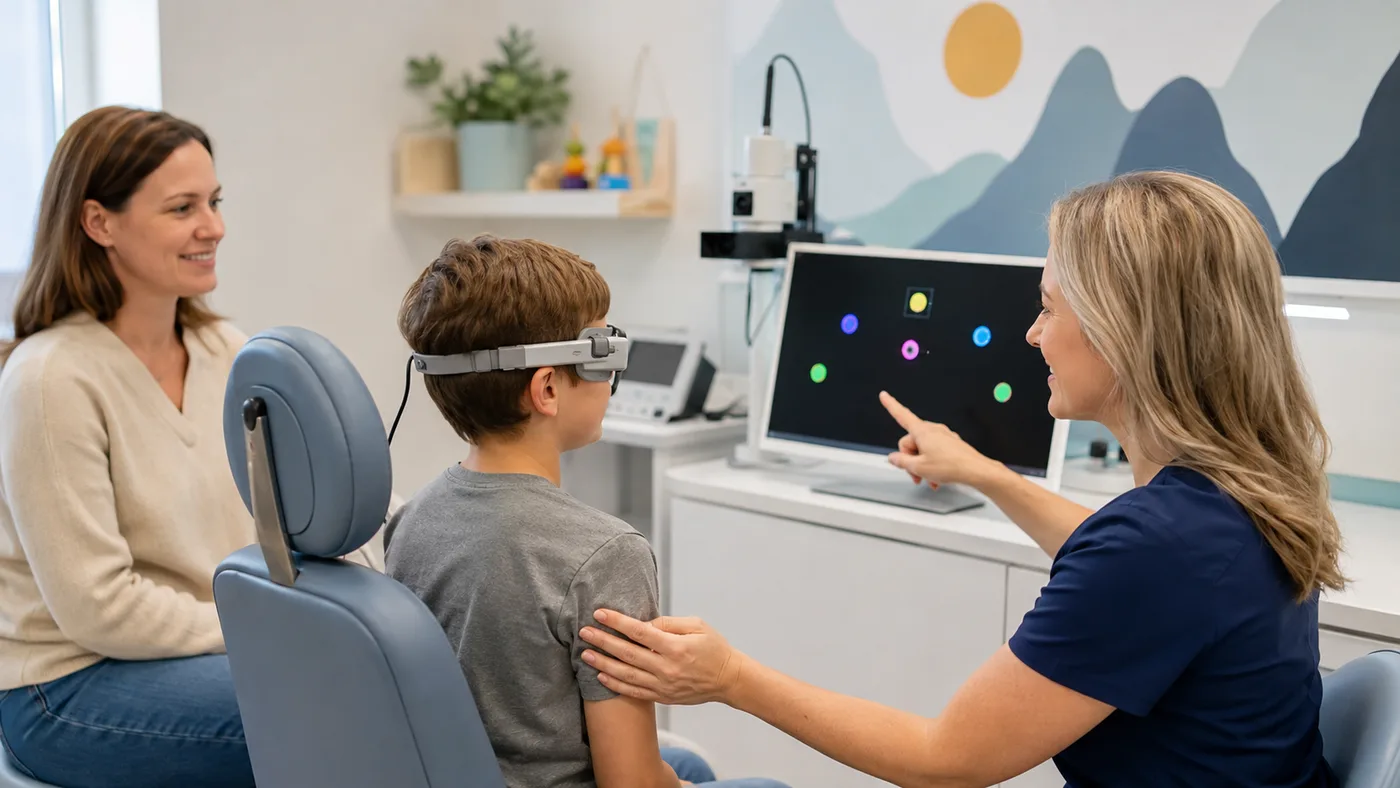
The Challenge
The vestibular system coordinates balance and eye movement. Clinicians evaluating dizziness, vertigo, unsteadiness, or suspected inner-ear and neurological problems often ask a child to keep their eyes open, track a target, and tolerate head movements while watching for nystagmus, involuntary rapid eye movements that can be diagnostically important.
The patients range from toddlers who cannot follow complex instructions to adolescents who struggle with repetitive exams. Relevant conditions include vestibular migraine, post-concussion syndrome, labyrinthitis, and developmental coordination disorders. When a child becomes anxious, distracted, or closes their eyes, the exam takes longer and may produce less reliable findings.
Today's examination is led by a vestibular physical therapist or ENT specialist using verbal instructions and ordinary visual targets. It works well for many adults, but children often require repeated instructions, comfort, and breaks.
Different parts of the assessment probe different functions. A video head impulse test records whether the eyes stay fixed on a target during brief head turns. Clinicians may also observe spontaneous or position-triggered nystagmus, test smooth pursuit and rapid gaze shifts, compare visual acuity with the head still versus moving, use a rotary chair, or record vestibular-evoked muscle responses. The game prototype should focus on one testable slice rather than claim to replace this full battery.
The Big Idea
Can a game make the child want to track the target, while a camera or eye-tracking setup captures clinically useful movement?
Clinician-Recommended Starting Points
Nurit Michelson, Tomer Hazan, and Hadas recommended three possible directions. Teams do not need to follow these exactly, but they are useful clinical starting points for a focused prototype.
- Gaze Stabilization & Head Impulse Game: the child keeps their eyes locked on a target while the therapist moves the head rapidly from side to side. The system tracks eye movement and gives feedback on saccades, instability, or nystagmus during the passive head thrust.
- VR Balloon Popping Challenge: the child focuses on a target in VR and moves the head rapidly, for example whipping side to side to pop a balloon. Eye tracking and headset motion sensors monitor vestibulo-ocular reflex behavior, gaze slippage, corrective saccades, or directional nystagmus.
- Fixed-Gaze Head Rotation for Adolescents: a teen-focused exercise where the player holds gaze on a stationary target while rotating the head. The system monitors eye stability and reports drifting, corrective saccades, or latent nystagmus.
What a Jam Prototype Could Be
- A child-friendly game that makes fixation, head rotation, and gaze stabilization feel like a challenge rather than an exam.
- A prototype that uses a standard camera, VR headset sensors, or eye-tracking sensor to capture eye movement during play and surface clinically relevant patterns.
- A clinician control panel for choosing the mode, target direction, speed, duration, required head movement, and review of recorded eye traces.
- A short session loop with immediate feedback, rewards, and breaks so the child stays engaged.
Design Questions
- Which of the clinician-recommended directions should a team prioritize for a 30-hour prototype?
- What target motion best maps to the vestibular exam or treatment goal?
- How can the game keep eyes open and attention locked on the target?
- What can be measured with ordinary cameras, VR headset sensors, or eye tracking in a prototype?
What This Is Not
- Not a diagnosis tool, treatment order, or replacement for clinical judgment.
- Not a place to use identifiable patient data.
- Not expected to be a finished hospital product after 30 hours.
Why This Matters
A successful prototype would keep children immersed with their eyes open and naturally tracking the target, reduce pauses and repeated instructions, and give the clinician a more useful record of gaze stability, corrective saccades, or nystagmus during the task.