Virtual Grossing Lab
Pathology / Surgical Specimens / Medical Training
The Challenge
Gross examination is a critical step in surgical pathology. Pathology residents and pathology assistants must orient a specimen, identify anatomical structures and lesions, measure them correctly, choose how and where to open or dissect it, and select tissue sections for microscopic examination.
Errors can be irreversible: a trainee may cut through an important margin, open an organ incorrectly, miss a small lesion or lymph node, disrupt an anatomical relationship, or choose sections that do not support diagnosis and staging. The challenge is especially important early in training and whenever an unfamiliar or complex specimen arrives.
Why Current Tools Fall Short
Training relies on textbooks, written grossing protocols, instructional videos, demonstrations, and supervised practice on real patient specimens. Written protocols do not fully teach the three-dimensional and procedural aspects, videos are passive, and available practice depends on which specimens happen to arrive.
Real specimens cannot be reset after a damaging cut or lost relationship. A learner therefore has little opportunity to compare approaches, repeat the same case, or progress systematically from common specimens to rare and complex ones.
Possible Directions
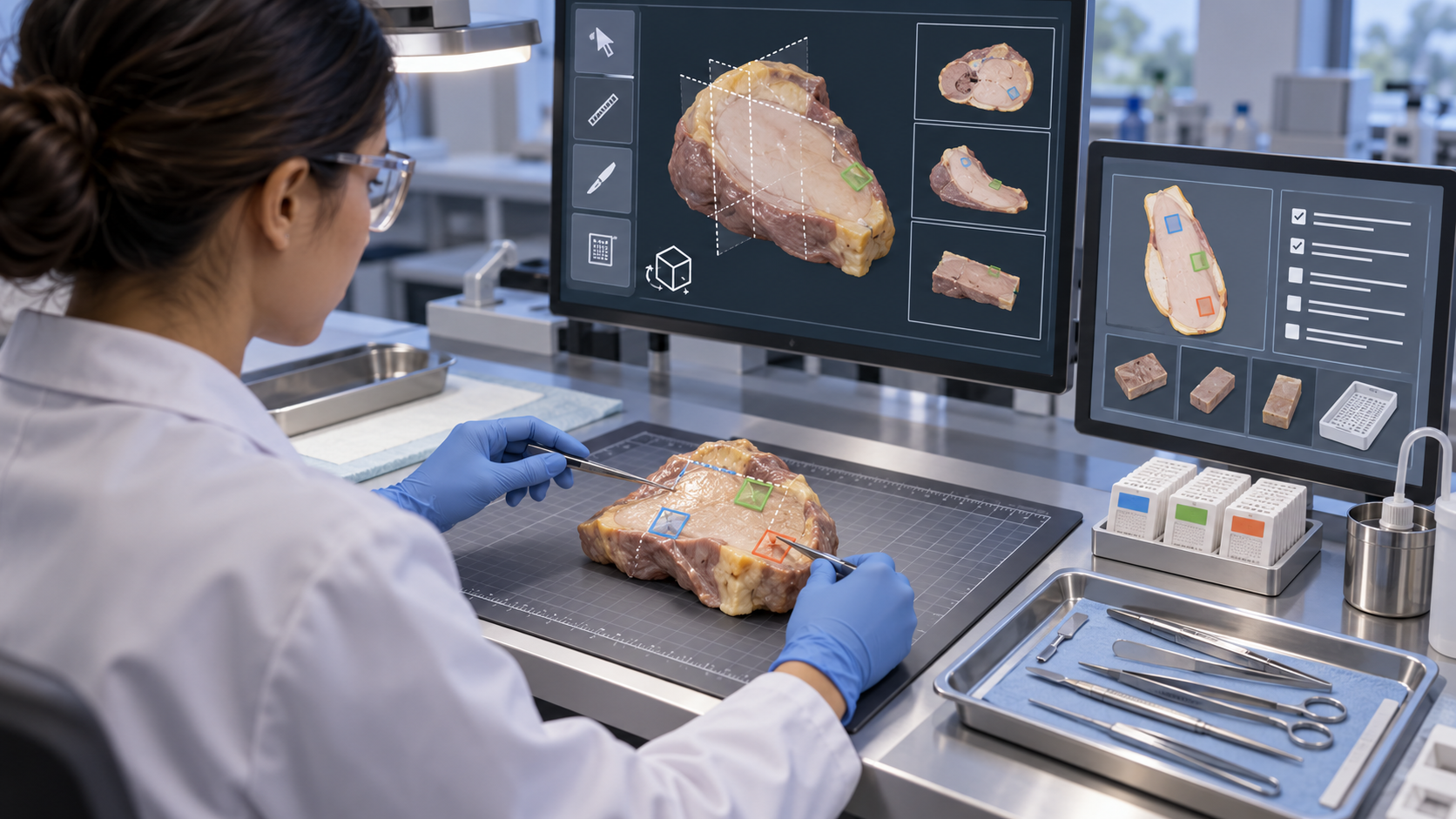
One possible direction is a repeatable virtual grossing case. The player receives a realistic clinical history and three-dimensional specimen, such as a colon resection, uterus, prostate, lung lobectomy, or another oncologic resection.
The player must identify and orient the specimen, examine anatomical structures and lesions, mark relevant surfaces and margins, decide where and how to open or cut, take the correct measurements, and select and label tissue sections for histology.
The game then reveals the underlying pathology and consequences of those decisions: Was the deepest tumor invasion sampled? Were surgical margins assessed? Were relevant lymph nodes found? Did the selected sections provide enough information for diagnosis, staging, and an accurate pathology report? Cases could be repeated, compared, and arranged from common to rare or complex.
What Success Could Look Like
- Correct orientation, opening, anatomical identification, lesion measurement, margin assessment, and tissue selection.
- Sufficient sections for diagnosis and staging without unnecessary sampling.
- Fewer damaging cuts, missed lesions, missed lymph nodes, and lost anatomical relationships.
- Improved performance on a standardized grossing assessment.
- Less direct supervision and clearer planning when approaching a real specimen.
- Tracked errors and improved completion time across repeated attempts.